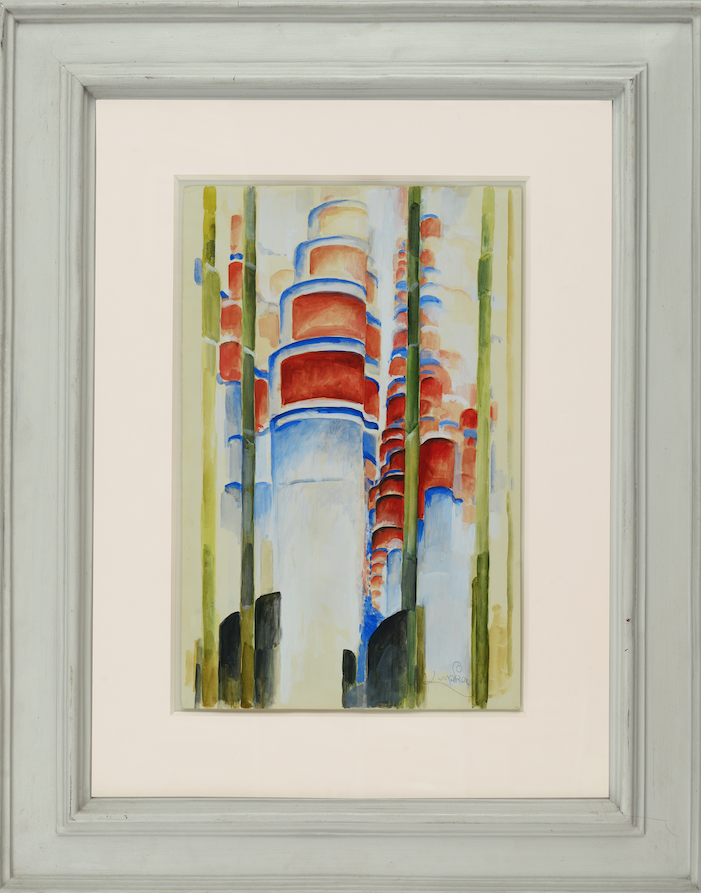
Kupka's gouache, La montée (Ascent), reflects his synthesis of the real world with the unseen forces and dimensions he sought to conjure in his work. Ethereal tiered, tapering towers appear crowded together in a seemingly infinite mass. In the foreground, four bamboo-like stems frame the scene, while also separating it from our world. While it resembles a cityscape, La montée (Ascent) depicts not a place, but an uncanny architectural arena of light, space, and energy.
In the 1920s, Kupka made numerous works featuring multitiered, light-infused vertical forms. He gave them titles that allude to ascension and growth. His visual references were varied: dramatic rock formations on the Brittany coast, soaring Gothic architecture, and the tiered, pyramidal towers of Hindu temple architecture. Humble phenomena could also stir Kupka’s imagination. La montée (Ascent) was inspired by glass jars of fruit preserves fermenting in the sun. The artist found dynamism and cosmic energy in vertical forms, writing: “The vertical is the solemn spinal column of life, the central axis of all construction; it monumentalizes even the most insignificant sketch.”
The rhythmic red and blue patterning on the towers of La montée (Ascent) gives the composition its sense of skyward thrust. Kupka often paired red and blue in his work, making use of the visual tension between the colors: red appears to advance, while blue seems to recede. Here he uses blue to delineate the towers’ segmentations and red to emphasize their roundedness. The four green stems amplify the sensation of upward movement, suggesting the potency of organic growth.
Kupka made La montée (Ascent) as a study for an oil painting, which is in the Batliner Collection, on permanent loan to the Albertina in Vienna. The work registers the energy of the artist’s hand, striving to give life to forms that could extend into a heavenly beyond.