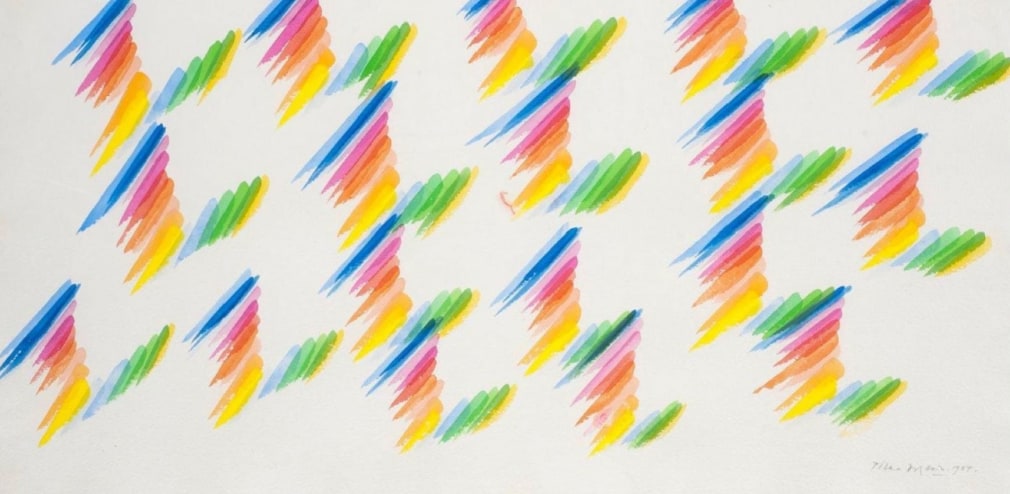
Born in Rome and trained in traditional classical painting and drawing, Dorazio (1927 – 2005) turned to architecture as a university student in 1945. In the late 1940s, Dorazio became active in a variety of artistic and literary circles, when he was exposed to a wealth of artistic influences and intellectual currents, from the School of Paris and Surrealist biomorphism to Russian Supremativism, Constructivism, and even Italian Futurism. Notably, he rediscovered the art of Giacomo Balla, whom he sought out in Rome in 1950 and visited often, studying the paintings and sketchbooks in the neglected Futurist's studio. At the same time, Dorazio became actively involved in design, printing silk-screens, and creating furniture. In 1950, a visit to Paris led to his collaboration with a number of fellow artists in organizing a notable avant-garde institution, L' Age d' Or. During the late 1940s and early 1950s, while traveling throughout Europe and visiting New York, Dorazio was evolving the approach that a decade later would establish his international renown.
In his urbane, tense abstractions, Dorazio has captured not life but rather a fleeting, emotionally charged glimpse of it in passing. Luminosity itself might be the subject of his delicately textured and atmospheric grids, embodying a lyricism that is both fragile and firmly constructed. In his watercolors of the late 1950s and 1960s, Dorazio tethers radiant bars of color to one another, creating pictorial textures that appear to be the inspired efforts of a weaver working with tensile bands of pure color and light. Yet Dorazio's elegant abstractions are not merely atmospheric and ethereal. As the tactile grids twist and writhe energetically across the surface, they reveal firm, fluid brushstrokes of great confidence.
Somehow, Dorazio strikes a balance between the rigidity of the grid format and this lush tactile surface treatment. With their pulsating masses of strong color and rough texture, the grids appear to have settled on the paper, as if through some mysterious natural process that is at once dynamic and graceful. In these monochromatic crosshatched grids, Dorazio has abandoned organic polychromatic gesture to focus on the essence of his compositions: the surface itself, patterned and infused with soft, tinted light. Each composition is rendered in exquisite, assured strokes, achieving a remarkable and highly personal synthesis of lyricism and a barely tangible formalism.
- 1927
- Born in Rome, Italy
- 1947
- Awarded a grant by the French Government to live in Paris for a year and enrolls in the Ecole des Beaux-Arts
- 1949
- Participates in Leopoldskron seminars in Salzburg. Contributes articles to the journals Giornale della Sera and Il Mondo
- 1950
- Studies architecture at the University of Rome. Organizes L'Age d'Or, a gallery bookshop and international meeting place for avant-garde artists and writers
- 1951
- Exhibits at the Triennale di Milano. Participates in a group exhibition at the Guggenheim Museum in New York. Becomes Italian correspondent for the magazines L'Architecture d'Aujourd'hui and Art d'Aujourd'hui
- 1952
- Wins scholarship to study in Paris. Publishes the magazine Arti Visive
- 1953
- Invited to participate in the international Summer Seminar at Harvard University and spends the next year in the U.S.
- 1955
- Publishes LA Fantasia dell'arte nella vita moderna, the first international survey of modern art to appear in Italy
- 1956
- Teaches drawing and mosaic techniques at the Positano Art Workshop
- 1958
- Experiments with new technique and produces a series of monochromatic paintings with overlapping brushstrokes
- 1960
- Appointed director of the department of painting, sculpture, and graphic art at the School of Fine Arts at the University of Pennsylvania
- 1962
- Participates in the founding of the Zero Group in Düsseldorf
- 1970
- Appointed curator of the Biennale di Venezia. Lectures in the Faculty of Architecture in Rome
- 1978
- Organizes the Scuola Atelier per la Ceramica Moderna in Todi
- 1984
- Begins to write art criticism for the newspaper Corriere della Sera
- 1996
- Publication of the Catalogo Generale (1962-1993) by Pananti in Florence
- 2005
- Dies in Perugia, Umbria
SOLO EXHIBITIONS
- 1953
- Wittenborn Gallery, New York
- 1954
- Rosa Fried Gallery, New York
- 1955
- Galleria Apollinaire, Milan
Galleria del Cavallino in Venice
- 1959
- Galerie Springer, Berlin
- 1960
- XXX Biennale di Venezia
- 1961
- Bienal de Sao Paolo, Brazil
- 1964/65
- Galeria Malborough, Rome. Exhibiton travels to sister gallery in New York
- 1966
- Erker Galerie in St. Gallen, with catalogue text by Giuseppe Ungaretti
XXXIII Biennale di Venezia
Marloborough Gallery, London
- 1969
- Marlborough Gallery, New York
- 1974
- Sala delle Pietre, Todi, Umbria
- 1977
- Andre Emmerich Gallery, New York
- 1979
- Travelling exhibition opens at the Musée d'Arte Moderne de la Ville de Paris, then tours the U.S. and Germany before closing at the Galleria Nazionale d'Arte Moderna in Rome in 1883
- 1985-86
- Seibu and Face Galleries, Tokyo
- 1986
- Achim Moeller Fine Art, New York
- 1988
- XLIII Biennale di Venezia
- 1990
- Erker Galerie, St. Gallen, Musee de Grenoble, Galleria Civica, Bologna
- 1993
- Galerie Artcurial, Paris
- 1994
- Municipal Gallery, Athens
- 1995
- Erker Gallery, St. Gallen, exhibition is accompanied by a volume of poetry by Mario Luzi
- 1996
- Retrospective exhibition of engravings at the Calcografia Nazionale in Rome
- 1999
- Retrospective exhibitions from the 1950s at the Studio Angeletti in Rome, Padiglione d'Arte Contemporanea in Milan, Galerie Valentin in Stuttgart
- 2000
- Dresdner Bank, Heidelberg
Achim Moeller Fine Art, New York
- 2002
- Galleria Ulisse, Rome
Galleria Cappelletti , Milan
Galerie Aras, Ravensburg
The Municipal Gallery, Rhodes
Galerie Valentin, Stuttgart
Achim Moeller Fine Art, New York
- 2003
- Retrospective at the Institut Valencia d'Art Modern, Valencia
- 2004
- Works from 1946-2003 at the Casa Rusca, Locarno; Achim Moeller Fine Art, Ltd.
GROUP EXHIBITIONS
- 1946
- Gruppo Arte Sociale (Achille Perilli, Mino Guerrini, Renzo Vespignani, among others)
- 1947
- Forma 1, the first group of Italian abstract artists (Guerrini, Perilli, Carla Accardi, Pietro Consagra, and Giulio Turcato)
- 1948
- helps to organize the inaugural exhibition Mostra Nazionale d'Arte Astratta at the Galleria di Roma
- 1951
- Triennale di Milan
Guggenheim Museum, New York
helps organize Arte Astratta e Concreta in Italia at the Galleria Nazionale d'Arte Moderna in Rome
- 1952
- XXVI Biennale di Venezia
- 1956
- Exhibitions in Rome and New York
XXVIII Biennale di Venezia
- 1957
- VIII Mostra Nazionale di Arte Contemporanea at the Museo Civico in Alessandria
- 1965
- The Responsive Eye at the Museum of Modern Art in New York
- 1973
- Plus by Minus at the Albright-Knox Gallery in Buffalo, New York
invited to be part of the permanent installation of the Zero Group at the Kunstmueum in
Düsseldorf
- 1987
- Forma 1 at the Bourg-en-Bresse and Darmstadt Museums
- 1991
- organizes Beauty is Difficult at the Museion-Museo d'Arte Moderna in Bolzano
- 1995
- Les Figures de la Liberte in Geneva
- 1996
- Face a l'histoire at the Centre Georges Pompidou in Paris
- 1998
- 50 Anni di lavori su carta, 1948-1998 at the Palazzo Crepadonna
- 2001
- Dorazio Jazz at the Museo d'Arte Moderna e Contemporanea in Bolzano
INTERNATIONAL AWARDS
- 1957
- Citta di Alessandria, most prestigious prize in Italy for contemporary art
- 1961
- Prix Kandinsky
International Prize of the Biennale de Paris
Declines award of 1 million French Francs in protest against war in Algeria
- 1968
- Award from the Deutscher Akademischer Austauschdienst
- 1970
- Awarded International Prize for Graphic Work by the city of Crakow
- 1986
- Prize of the President of the Republic from the Accademia di San Luca in Rome
- 1991
- Elected to the Akademie der Künste in Berlin and the Accademia di San Luca in Rome which awards him the Alcide de Gasperi Prize
- 1997
- Michelangelo Prize awarded by the Accademia dei Virtuosi del Pantheon
- 2000
- Scipione Prize by the Fondazione Carima